
Best 0DTE Options Tools and Strategies

0DTE options can turn a small market move into a fast win, or erase the full premium before lunch. These contracts expire the same day, so price, time, and implied volatility all hit your P&L at once. Here are the tools and strategies worth knowing, plus the risk rules that keep a fast trade from becoming a dumb one.
1. AlgoX Flow - live flow and 0DTE market analysis
AlgoX Flow is an options-market analysis and education platform built for traders who need live context during the session. It combines live options flow, gamma exposure tools, earnings analysis, and trade alerts.
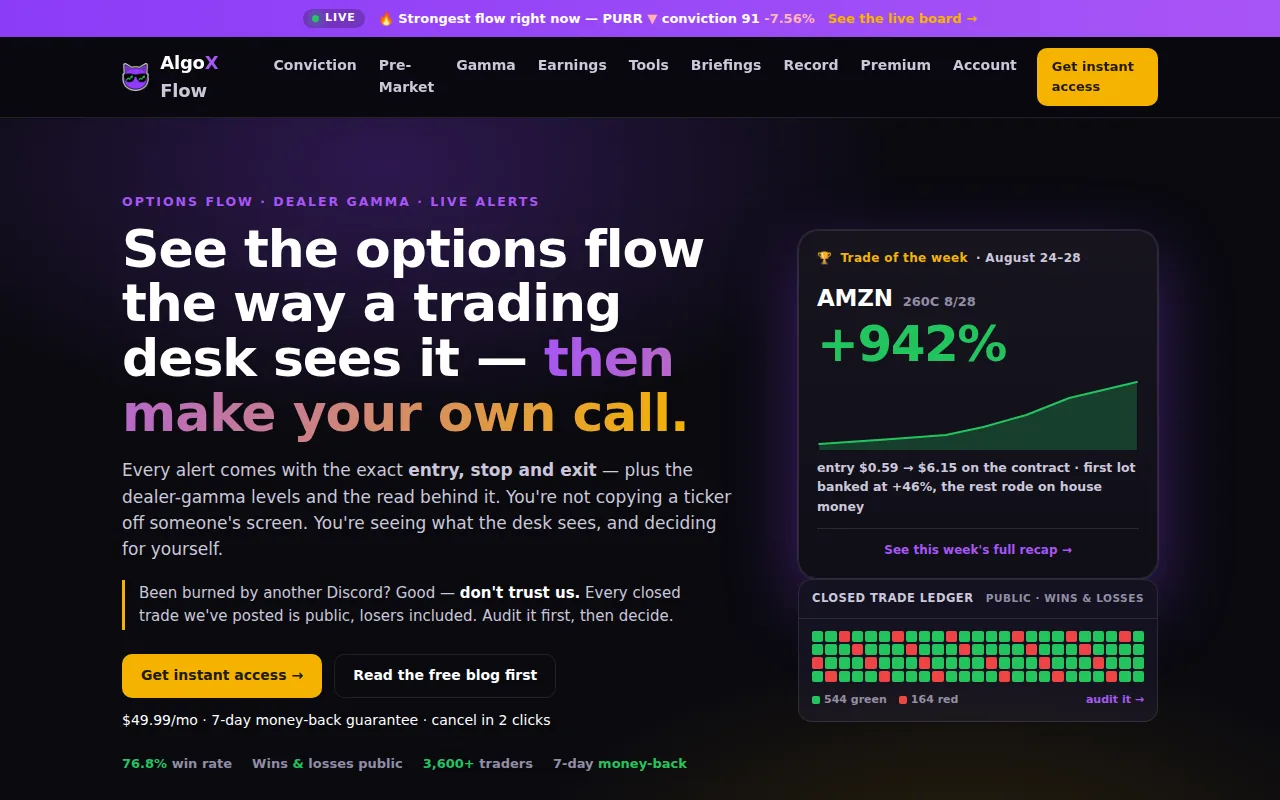
For 0DTE options, the main edge is having several lenses in one workspace. Flow can show where large trades hit the tape. Gamma exposure can help you mark areas where dealer hedging may add pressure or absorb movement. The earnings analyzer helps frame a catalyst before you buy premium. Alerts can keep you from staring at every strike all day.
We don't pretend a flow print is a trade signal by itself. A large call order may be a hedge, a spread leg, or part of a larger position. You still need price action, liquidity, and a defined exit. Our guide to reading options flow covers the difference between ask-side trades, bid-side trades, sweeps, and blocks.
AlgoX Flow is the strongest fit for serious options traders who want dedicated 0DTE analysis. The trade-off is clear. Its public information does not disclose data latency or list a free tier, so ultra-fast traders should test execution and cost before sizing up.
Educational, not financial advice. Check the proof, then decide.
2. Quant Data - real-time options order flow for non-professionals
Quant Data is a real-time options order flow service aimed at non-professionals. It has a web dashboard plus mobile apps, along with more than 30 trading tools.
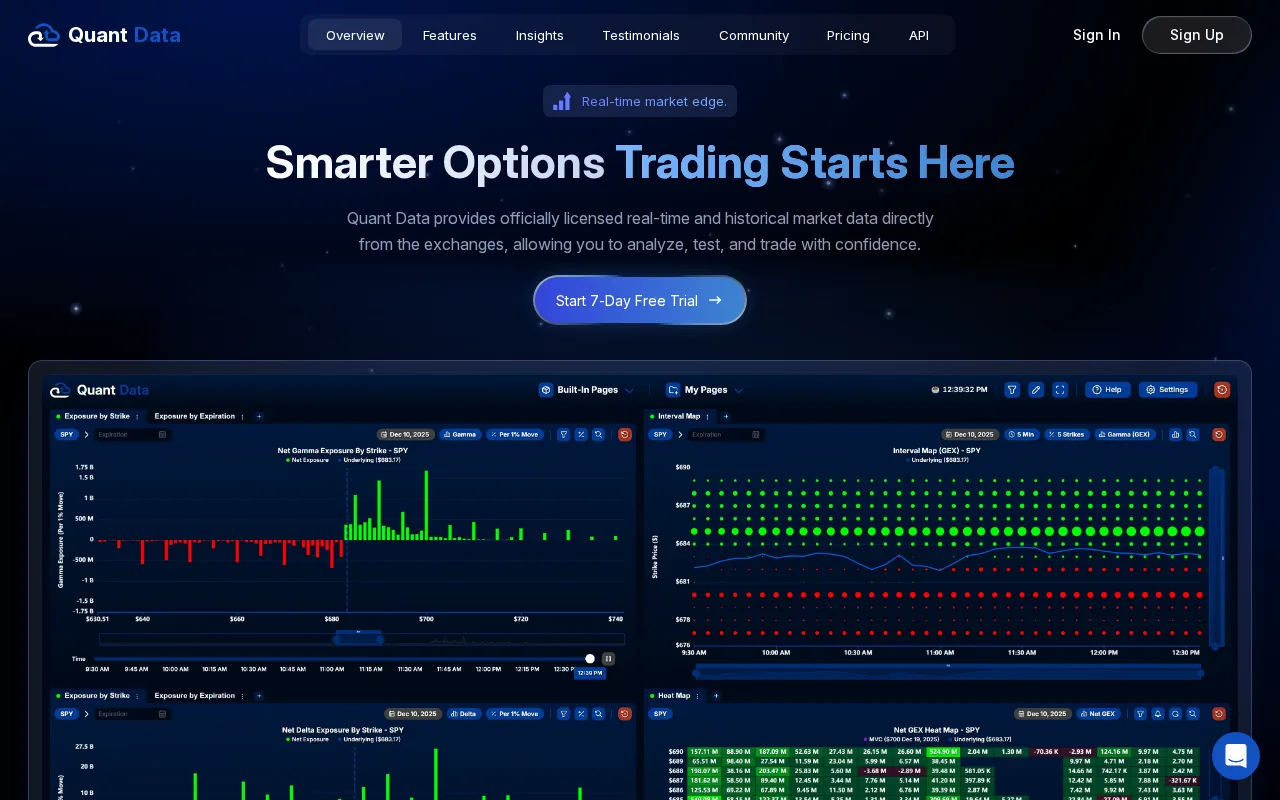
Its listed tools include order flow, volatility data, open interest, max pain, dark pool levels, dealer positioning, news, filters, and alerts.
Quant Data also lists a seven-day free trial. That gives a newer trader a way to test the dashboard before paying.
Use it if real-time flow is your main need and you want a trial first. Don't mistake a free trial for a trading edge. The edge still has to come from your rules.
3. optionsblackbelt.com - classes and live sessions for options education
optionsblackbelt.com is the education-first option in this shortlist.

A class can teach delta, gamma, theta, IV, and spread construction. It cannot replace a live read of the tape during a sharp intraday move. If you are still mixing up debit and credit spreads, structured lessons may save you from expensive trial and error.
This is the better fit for a trader who needs study time before placing same-day trades. Trade only after you can explain the max loss without checking a cheat sheet.
4. Buying 0DTE Calls - direct bullish exposure with rapid decay
Buying a 0DTE call is the cleanest bullish bet. You pay a premium for the right to buy the underlying at the strike price before expiration.
The appeal is obvious. A call can cost less than buying 100 shares, while a quick move can produce a large percentage gain. But the low dollar cost tricks traders into oversizing. If the underlying stalls, theta can drain the option minute by minute. A call that moves in the right direction may still lose if it moves too slowly.
Delta shows your directional exposure. Gamma shows how quickly that exposure can change near the strike. On expiration day, both deserve constant attention. An out-of-the-money call with a tiny delta may look cheap because the market assigns it a low chance of finishing in the money. For definitions of delta, gamma, theta, IV, and moneyness, see this options trading glossary.
Look for a clear catalyst, such as breaking news, major economic data, or a clean momentum break. Avoid buying after IV has already exploded unless price still has room to move. A late entry can suffer from volatility crush even when your direction is right.
Set the dollar loss before entry. Never use the cheap premium as an excuse to buy five times more contracts.
5. Buying 0DTE Puts - bearish trades and short-term hedging
Buying a 0DTE put gives you bearish exposure or a short-term hedge. The put buyer has the right to sell the underlying at the strike price, while the maximum planned loss is the premium paid.
This setup can fit a sharp downside thesis. A failed breakout, bad news, or fast market drop may lift the put while the underlying falls. But timing still rules the trade. A slow decline may not offset theta, especially when the put starts out of the money.
A put can also protect shares during a known risk window. Suppose you hold an ETF and expect a major data release to cause a sharp move. A same-day put may limit part of that session's downside, but the hedge expires quickly. You pay for protection that may become worthless if the feared move never arrives.
Standard equity and ETF options usually represent 100 shares per contract. They can also carry early assignment risk because they use American-style exercise.
Use puts for a defined event or a clear technical break. Don't buy them because the chart feels heavy.
6. Vertical Spreads - defined-risk directional trades
A vertical spread pairs two options with the same expiration and different strikes. It gives you a directional view with a known maximum loss at entry.
A long call vertical is bullish. You buy the nearer call and sell a higher-strike call. A long put vertical is bearish. You buy the nearer put and sell a lower-strike put. These debit spreads cost less than a single long option, but the short leg caps your maximum gain.
Credit verticals reverse the cash flow. A bull put spread sells a put closer to the money and buys a lower put for protection. A bear call spread sells a call closer to the money and buys a higher call. You collect a credit, but the spread width sets the risk ceiling.
Buying spreads generally fits lower IV conditions. Selling spreads fits higher IV when you expect premium to contract. Either way, calculate the width minus the credit or add the debit before sending the order. The broker's risk graph is not decoration.
A sensible management rule is to close a profitable spread before expiration rather than fight the last few cents. The closer the clock gets to the bell, the less room you have to fix an ugly position.
7. Iron Condors - range-bound setups around expected moves
An iron condor combines a bull put spread with a bear call spread. It suits a market that should stay inside a defined range through expiration.
You sell an out-of-the-money put and call, then buy farther-out wings. The short strikes form the profit zone. The long wings cap the loss. If price stays between the short strikes, time decay can reduce the spread's value and leave the seller with the credit.
Iron condors work best when price action is quiet but IV is high enough to pay you for the risk. A range-bound chart near the middle of its expected move is more useful than a random guess about support and resistance.
The danger is the win-rate trap. Many small wins can sit beside one sharp loss. A fast breakout can test one side before you have time to adjust. Define the maximum loss, avoid oversized wings, and close before expiration if the position no longer fits the plan.
Watch the video below for a visual explanation of short-duration structures and asymmetric risk.
8. Straddles and Strangles - trading large volatility moves
Straddles and strangles trade volatility more than direction. Long versions need a large move. Short versions need price to stay calm.
A long straddle buys a call and put at the same strike. It can fit a major event when you expect a large move but don't know the direction. The combined premium sets the hurdle. Price must move far enough to cover both premiums, before time decay eats the position.
A long strangle uses different out-of-the-money strikes. It costs less than a straddle, but the underlying must travel farther before the trade can profit. That structure may suit a trader with a directional lean and a strong volatility thesis.
Short straddles and strangles are a different beast. They collect premium when price stays inside the break-even range, but losses can become very large. A short call can create theoretically unlimited risk. Most traders should not sell these naked, especially on an expiration day.
Check IV percentile before selling premium. High IV can improve the credit, but it can also signal that the market expects a violent move. Cheap-looking long premium is not automatically cheap. Expensive short premium is not automatically safe.
9. SPX, SPY, and XSP - major index and ETF underlyings
SPX, SPY, and XSP are popular underlyings for 0DTE options because they track the S&P 500 in different forms. Their settlement rules matter as much as their liquidity.
SPY is an ETF. Its options are physically settled, so an in-the-money option held through expiration can result in shares changing hands. SPX and XSP are index options with cash settlement. That means the position settles to a cash amount instead of delivering ETF shares.
| Underlying | Structure | Settlement issue | Best use case |
|---|---|---|---|
| SPX | S&P 500 index option | Cash settled | Large index exposure with no ETF shares delivered |
| XSP | Mini-SPX index option | Cash settled | Smaller index exposure with cash settlement |
| SPY | S&P 500 ETF option | Physically settled | Liquid ETF trading with assignment risk |
Liquidity still matters. A tight spread helps, but it doesn't remove gap risk or fast reversals. Know the multiplier, settlement style, and broker cutoff before placing the trade.
10. 0DTE Credit Spreads - defined-risk income approaches
0DTE credit spreads collect a net premium while using a long option to cap the short option's risk. They are built for traders who want a defined range of outcomes.
A bull put spread needs price to stay above the short put. A bear call spread needs price to stay below the short call. In both cases, the credit is the most you can make before fees. Maximum loss is the spread width minus the credit, multiplied by the contract size.
The setup can work when IV is improved and the expected move looks wider than the distance to your short strike. But high IV often has a reason. News can push price through the short strike faster than theta can help.
Do not treat a high probability of profit as a promise. One full loss can erase several small credits. Set a daily loss limit, cap the number of trades, and stop after a rule breach. A credit spread is defined risk only if you respect the defined risk.
For a rules-based workflow, track entry credit, spread width, break-even, exit price, and actual slippage. Your journal should show whether the idea worked or the fill merely looked good on paper.
FAQ
What are 0DTE options?
0DTE options are contracts traded on the same day they expire. They may have only hours left, so theta decay and price changes affect the premium quickly. The contract can finish with intrinsic value or expire worthless. That compressed time frame makes entry timing, liquidity, and position size more important than usual.
Are 0DTE options good for beginners?
0DTE options are usually a poor starting point for beginners because losses can arrive within minutes. New traders should first understand delta, gamma, theta, IV, assignment, and contract size. Paper trading can help test rules, but it cannot fully copy live fills or emotional pressure. Start small if you trade at all.
What is the safest 0DTE strategy?
No 0DTE strategy is safe, but defined-risk spreads cap the loss at entry. Vertical spreads and iron condors use long options to limit risk. The cap only works when the position is sized correctly and managed before expiration. Single calls and puts have a clear maximum loss, but the full premium can still disappear.
Can you make money with 0DTE options?
You can make money with 0DTE options, but a winning trade needs the right direction, speed, and volatility conditions. A slow move may still lose because theta keeps working. Short premium can benefit from decay, while long premium needs movement. Keep a trade log instead of judging the method by one large win.
What are the biggest risks of same-day options?
The biggest risks include rapid time decay, IV crush, poor fills, sudden reversals, and oversized positions. Short options add assignment and expansion risk. Market hedging around major strikes can also intensify intraday moves. Set a maximum loss before entry, limit daily trades, and avoid holding contracts you don't understand into expiration.
Conclusion
Start with a defined-risk structure and a clear catalyst, not a cheap out-of-the-money contract. AlgoX Flow is the strongest first stop for traders who need live flow, gamma context, earnings analysis, and alerts in one place. Audit the data, paper-test your rules, then risk only an amount you can lose without revenge trading. Educational, not financial advice.