
The 0DTE Toolkit: 10 Tools for Flow, Volatility and Fast Risk

0DTE options can move from cheap to worthless before you finish your coffee. That speed is the appeal, and the trap. Here are the best tools for reading flow, judging volatility, planning spreads, and managing fast trades without pretending risk disappeared.
Table of Contents
- AlgoX Flow
- Gamma and Dealer-Positioning Analysis
- Options Volatility and Unusual-Options Data
- Visual Strategy Analysis
- Advanced Charting and Paper Trading
- Multi-Market Brokerage Platforms, Global Execution and Risk Controls
- Defined-Risk Spread Education
- Intraday Charts, Alerts and Macro Context
- Options Screening and Probability Filters
- Quantitative Options and Volatility Analytics
- FAQ
- Conclusion
1. AlgoX Flow
AlgoX Flow is an options-market analysis and education platform built for traders who need live flow and market context. It’s best for retail traders who want alerts, gamma data, earnings analysis, and trade ideas in one place.
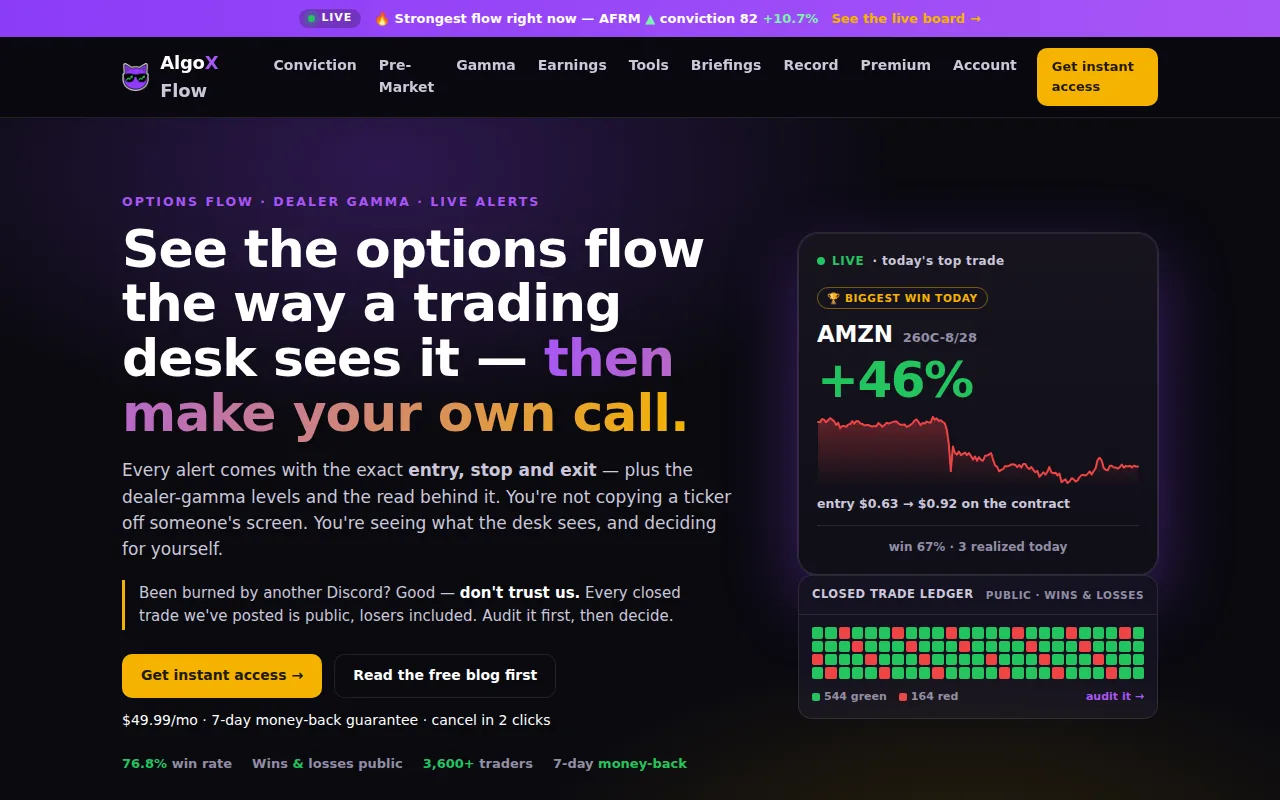
We focus on the data that can shape a 0DTE decision. Live options flow can show where large trades hit the tape. Gamma exposure can help you watch areas where dealer hedging may affect price action. The earnings analyzer adds a useful filter when a stock has a scheduled catalyst.
That matters because a cheap contract alone tells you almost nothing. You need to know if the tape supports the move, whether implied volatility already prices in the event, and where the trade fails. Our guide to reading options flow covers sweeps, blocks, bids, and asks without the usual Discord-room fog.
AlgoX Flow isn’t a magic entry button. Alerts still need a plan, defined risk, and a reason to exit. Educational, not financial advice. Good. Don’t trust us blindly. Check the proof, then decide.
2. Gamma and Dealer-Positioning Analysis
Market-structure research tools are aimed at traders who track gamma levels and dealer positioning. They’re best for people who want a map of possible support, resistance, and pin zones before entering a 0DTE trade.

Gamma measures how quickly an option’s delta changes as the underlying moves. That matters more near expiration because small moves can change delta very fast.
A trader might use gamma levels to frame a morning range. If price holds above a key zone, a bullish debit spread may have room. If price stays trapped inside a range, an iron condor may fit better. If price breaks through the level, the same setup can become dangerous within minutes.
The caveat is simple: positioning data is a map, not a forecast. Dealer hedging can change as new trades hit the tape. Treat levels as areas to test, not walls that must hold.
3. Options Volatility and Unusual-Options Data
An options-data platform can help traders screen unusual options activity and volatility. It’s best for traders who want to compare current option pricing with broader market conditions before buying premium.

0DTE contracts have almost no time value left. Theta can drain a long option throughout the session, even when the underlying eventually moves in the right direction. Implied volatility can also fall after a scheduled event, which may hurt a long option even if price behaves well.
Use a volatility screen to ask better questions. Is IV improved because of earnings? Is the expected move wide enough to justify a directional trade? Is the option expensive because the market already expects the move? Our implied move calculator can help frame the expected range before you pick a strike.
An options-data platform won’t solve trade timing. A scan can find unusual volume, but volume alone doesn’t reveal intent. A large print may hedge another position. Read the contract, strike, expiration, and price together.
That small bit of discipline keeps a noisy scanner from becoming a slot machine.
4. Visual Strategy Analysis
A visual options strategy tool helps traders build positions and view their possible payoff. It’s best for traders comparing long calls, put spreads, credit spreads, iron condors, and other structures before sending an order.
Visual planning helps when a 0DTE chain gets messy. You can see the entry debit or credit, the breakeven level, and the payoff shape. That makes it easier to spot a trade that risks far more than its credit suggests.
A bull call spread can cap risk, but it also caps profit. A short put spread can benefit from time decay, yet a fast move through the short strike can erase several small wins. An iron condor adds a call spread to a put spread, so the market must stay inside a range for the best outcome.
Research on 0DTE strategies often compares these structures by market condition. Long premium needs movement. Credit spreads need price to stay away from the short strike. The tool shows the math, but it doesn’t tell you which condition will occur.
Use it before the trade, not after the loss. That’s when the payoff picture can still change your mind.
5. Advanced Charting and Paper Trading
Advanced charting and paper-trading platforms provide tools for traders who need to rehearse fast decisions before risking money in a 0DTE position.
Paper trading can expose weak habits. Do you chase a candle after the move? Do you widen a stop? Do you hold a losing option because the premium was cheap? Those mistakes show up quickly when time decay works minute by minute.
A 0DTE option reacts to price, implied volatility, and the clock. Gamma makes delta change quickly near the strike. Theta can remove value while the underlying barely moves. Official educational material from Schwab also warns that near-expiration options can face sharp price swings, slippage, and liquidity problems.
Use charts to mark the opening range, scheduled news, and your invalidation point. Then practice the exact order type and size you expect to use. A paper win proves little. A repeatable process is the useful part.
The limitation is execution reality. Paper fills may not match live fills, especially when spreads widen during a sharp move.
6. Multi-Market Brokerage Platforms, Global Execution and Risk Controls
A multi-market brokerage platform with advanced order and risk-control features can suit experienced traders who need detailed execution controls and access to more than one market.
Fast options trading punishes vague orders. A market order may fill badly when the bid and ask widen. A limit order may protect price but fail to fill. Traders need to understand the tradeoff before volatility spikes.
Risk controls matter even more with uncovered positions. A short call can carry theoretically unlimited loss if the underlying rises sharply. Defined-risk spreads put a ceiling on the loss, though that ceiling may still be too large for the account.
Set the maximum loss before entry. Decide what happens if price reaches the short strike. Decide what happens if the spread doubles in value. Stops can help, but they don’t guarantee a specific exit price during a fast market.
Advanced platforms can be powerful. That also means they can expose a weak process faster. More buttons won’t fix oversized risk.
7. Defined-Risk Spread Education
Trading education focused on options structures is best for traders who want to study defined-risk spreads before applying them to short-dated contracts.
Vertical spreads are common in 0DTE trading because they reduce capital needs compared with uncovered positions. A credit spread sells one option and buys protection farther out. The credit is limited, and the maximum loss is tied to the strike width minus that credit.
Iron condors combine a put spread with a call spread. They fit a range view, but they can lose quickly when a news event drives price through one side. A straddle takes a different view. It needs a large move because the trader pays for both a call and a put.
Education helps you understand the structure. It doesn’t remove gamma risk or emotional pressure. A spread that looks small on a chart can still produce a large account hit when repeated too often.
Keep the position size boring. Boring is useful when the clock is running out.
8. Intraday Charts, Alerts and Macro Context
A charting and alert platform can help track intraday price action and wider market context. It’s best for traders who want clean charts beside an options chain.
Charts help you see whether a move has follow-through. A single candle can attract buyers, then fail at the opening range high. An alert can pull your attention to a level without forcing you to stare at the screen all day.
That break matters for mental health. 0DTE trading can turn into hours of screen-watching, revenge trades, and constant P&L checks. Set a session window. Take a break after a loss. Stop trading when your rules stop feeling real.
Macro events deserve their own alert plan. Inflation data, central-bank statements, and employment news can expand volatility fast. A range trade placed before such an event may face a very different market minutes later. This is where chart context should meet an economic calendar, not replace it.
A charting and alert platform is a strong context tool. It isn’t an options risk engine, so pair it with a payoff calculator and a hard loss limit.
9. Options Screening and Probability Filters
An options screening tool helps traders filter contracts by strategy and probability measures. It’s best for users who want to narrow a large chain before studying individual trades.
Screeners can reduce random strike picking. You might filter for a delta range, a target expiration, or a spread structure. Then you can inspect the premium, breakeven, and distance from the current price.
Probability is where traders get careless. A high theoretical probability of profit doesn’t mean the trade has a good payoff. A credit spread may win often while one sharp loss wipes out many prior credits. With 0DTE options, the estimate can also shift rapidly as price and IV change.
Use probability as one input. Add the catalyst, liquidity, spread width, and planned exit. If you can’t explain the loss before entry, the screen has done too much work for you.
The best filter is still a rule that keeps you from forcing a trade.
10. Quantitative Options and Volatility Analytics
Quantitative volatility analytics tools focus on quantitative volatility data. They’re best for advanced traders who compare implied volatility, expected movement, and historical patterns.
For 0DTE work, the key question is often simple: is the option priced for more movement than you expect? If yes, selling defined-risk premium may deserve a look. If the market is underpricing a known catalyst, long premium may have a case. Neither view works without a clear exit.
Longer-dated options spread time decay across weeks or months. Same-day contracts compress that decay into one session. Their IV can rise before an event, then fall after the headline passes. Price can also move through the strike while the option loses value because the clock wins.
| Trading need | Useful tool type | What to verify before entry |
|---|---|---|
| Flow and positioning | AlgoX Flow or gamma analytics | Trade size, strike, expiration, and follow-through |
| Volatility view | Market-data platforms for screening unusual options activity and volatility | IV level, expected move, and catalyst timing |
| Payoff planning | Visual tools for building options positions and viewing their possible payoff | Breakeven, max loss, and spread width |
| Execution practice | Trading platforms with advanced charting and paper-trading functions or a paper account | Order behavior, fills, and exit rules |
| Chart context | Charting and alert platforms used to track intraday price action and wider market context | Key levels, trend failure, and alert points |
Quantitative volatility analytics can be too deep for someone who only wants a quick alert. That’s fine. Match the tool to the decision. More data can sharpen a plan, but it can also bury a weak thesis.
For a simpler workflow, AlgoX Flow keeps flow, gamma, and event analysis closer to the trading screen. Audit the data. Then decide if the setup deserves risk.
FAQ
What are 0DTE options?
0DTE options are contracts that expire on the same trading day. Their value can change sharply because only hours remain for the underlying asset to move. Theta removes time value quickly, while gamma makes delta more sensitive near the strike. They can produce fast gains, but the full premium can also disappear.
Are 0DTE options good for beginners?
0DTE options usually aren’t a good starting point for beginners. The trader must understand Greeks, order fills, position size, and expiration risk before trading live. Paper trading can help, but it won’t copy every live fill. Start with defined-risk structures and a loss limit you can follow without changing it.
What is the best tool for 0DTE options flow?
The best tool depends on the data you need, but AlgoX Flow is the strongest first pick for live flow, gamma exposure, earnings analysis, and trade alerts. Flow still needs context. Check whether the contract supports a clear thesis, then define the entry and exit. Educational, not financial advice.
What strategies work with same-day options?
Common 0DTE strategies include long calls, long puts, vertical spreads, credit spreads, iron condors, and straddles. Long options need a fast move. Credit spreads need price to stay away from the short strike. Iron condors need a range. Every setup needs a maximum loss and an exit rule.
Why do 0DTE options lose value so fast?
0DTE options lose value quickly because almost no time remains before expiration. Theta accelerates as the clock runs down. If the underlying fails to move far enough, an option can decay even when the trader’s direction is eventually right. Implied volatility can also fall after a scheduled event.
How much should I risk on a 0DTE trade?
Risk only an amount you can lose without changing your next decision. There is no universal dollar amount that fits every account. Define the maximum loss before entry, then size the position from that number. Never treat a cheap premium as low risk. Cheap contracts can still produce repeated losses.
Conclusion
Start with AlgoX Flow if you want one place to review live flow, gamma, and event risk. Pair it with a payoff tool and paper trading before you size up. Check the proof, set the loss limit, and make the next trade only when your rules still hold.