
0DTE Meaning Explained: 10 Facts About Same-Day Expiry

0DTE options can turn a market view into a result before the closing bell. That speed is the appeal, and the trap. Here are 10 key facts that explain what 0DTE means, how these contracts move, which structures traders use, and where the risk gets ugly.
Table of Contents
- AlgoX Flow
- Broad-Market Index 0DTE Options - High Liquidity and Cash Settlement
- Smaller-Size Index Options
- Equity and ETF 0DTE Options - Underlying-Specific Liquidity
- Long Calls and Puts - Directional 0DTE Bets
- Vertical Spreads - Defined-Risk 0DTE Positioning
- Credit Spreads and Iron Condors - Premium-Selling Structures
- News-Driven 0DTE Trades - Volatility and Event Exposure
- Short-Term 0DTE Hedges - Managing Intraday Portfolio Risk
- Algorithmic 0DTE Setups - Backtesting, Gamma, and Execution
- FAQ: 0DTE Meaning and Trading Questions
- Conclusion
1. AlgoX Flow
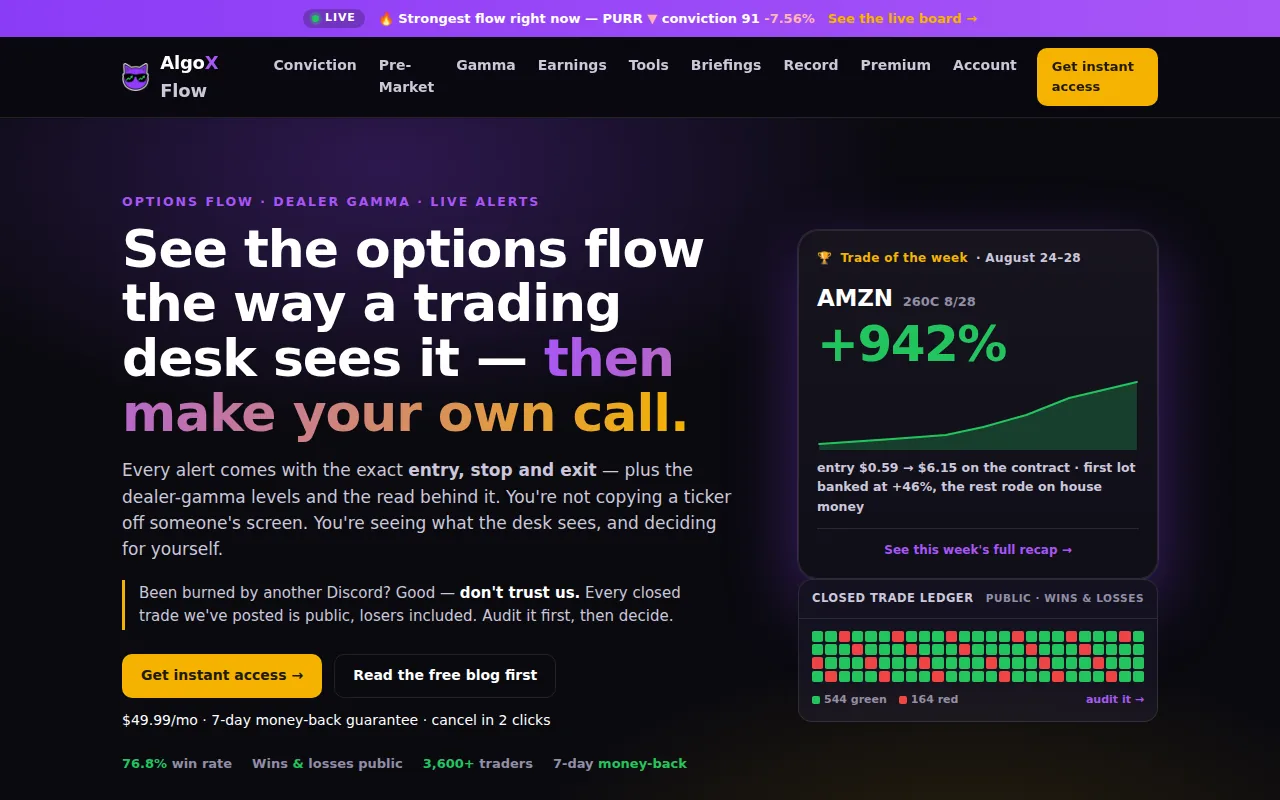
AlgoX Flow is an options-market analysis and education platform built for traders who need live context around fast trades. For the 0DTE trader, that means live options flow, gamma-exposure analysis, earnings insights, and trade alerts in one workspace.
The 0dte meaning is simple. The option expires at the end of the current trading day. The hard part is seeing what may push price toward a strike before time runs out. A flow print can show where money is trading, while gamma data can show where hedging pressure may change the tape.
We don't present a cheap call as proof of a setup. We look at the underlying move, the strike, the expiration, and the flow behind the trade. That distinction matters because a large premium print can be a hedge, a spread leg, or a closing trade. Read it wrong and the chart won't save you.
AlgoX Flow also fits traders who want an audit trail instead of guru theater. Green days and red days both get posted. Good. Don't trust us. Check the proof, then decide. The platform is educational, not financial advice.
Its limitation is just as plain: data cannot remove risk. A live alert may arrive during a fast move. Gamma can change before you act. You still need a defined entry, exit, and loss limit.
Start with the options flow reading guide before treating any large trade as a signal.
Key Takeaway: A live data tool can improve your read of a fast market, but it cannot turn a risky contract into a safe one.
2. Broad-Market Index 0DTE Options - High Liquidity and Cash Settlement
Broad-market index 0DTE options track a major stock index and expire the same day. They are a common choice for traders who want broad index exposure without taking delivery of shares.

A broad-market index is an index, not a stock. That means its options settle in cash. A trader with an in-the-money European-style index option does not wake up holding hundreds of shares. The gain or loss is settled through the account based on the final value.
That setup can be cleaner than an ETF position near expiration. With American-style equity and ETF options, exercise or assignment can move shares between accounts. A short in-the-money call can create a large stock obligation. Cash-settled index options avoid that physical delivery issue, but their contract size can be too large for a small account.
Broad-market index options also have deep trading interest. Research cited by Schwab puts daily 0DTE activity at roughly 1.5 million contracts, close to half of index option volume. High volume does not guarantee a good fill. A fast market can still widen spreads and cause slippage.
Strike spacing and fees also affect the trade. Broad-market index options commonly use wider strike gaps than smaller ETF contracts. That gives less precision when you set a spread, although fewer contracts may be needed for a similar notional position.
Before trading, review the basic structure of an options contract. Then check the expiration time, settlement type, and the exact risk shown by your broker.
Broad-market index options work best for traders who understand index settlement and can handle their size. They are a poor place to learn by clicking first and reading later.
3. Smaller-Size Index Options
Smaller-size index options can give traders broad index exposure with a less blunt approach to position sizing. The smaller scale may make it easier to adjust exposure.

That matters when your view is right but your account cannot absorb a larger index position. A trader can use fewer dollars per contract while keeping a broad index as the underlying reference. The risk remains high because the contract still expires today.
Some index options use a cash-settlement model. You need to confirm the exact product terms with your broker before entry. Product names can look similar while their settlement rules differ.
Use the table below as a decision aid, not as a trade signal.
| Question | SPX | Smaller-size index options | What it changes |
|---|---|---|---|
| Index exposure | S&P 500 | Broad index exposure | Both reflect broad index movement. |
| Contract scale | Standard size | Smaller size | Smaller-size options allow finer sizing. |
| Settlement style | Cash settled | May vary by product | Confirm settlement terms before entry. |
| Best fit | Larger exposure | Smaller exposure | Choose based on account size and risk limits. |
| Main warning | Large notional risk | Fast decay and gamma | Smaller does not mean safe. |
Liquidity can vary by strike and time of day. A product may look active at the center of the chain and thin farther out. Work limit orders rather than assuming the displayed midpoint is fillable.
The 0dte meaning stays unchanged with smaller-size index options: zero days remain on the clock. The smaller contract only changes the dollar scale.
4. Equity and ETF 0DTE Options - Underlying-Specific Liquidity
Equity and ETF 0DTE options expire that day while tracking one stock or a basket of stocks. Their behavior depends heavily on the underlying, not just the expiration label.
An active ETF can have a deep chain near the current price. A thin single-stock chain may show a wide bid-ask spread even when the stock itself looks busy. That gap becomes expensive when you need out fast.
ETF options also bring physical settlement and possible assignment. If you sell a contract and hold it through expiration, know what delivery could mean for your account. A short call can leave you short shares after assignment. A short put can create a long share position.
Underlying-specific news changes the whole setup. A product announcement can push implied volatility higher before the event. The option may look cheap in dollar terms but still carry a large break-even move.
Use the chain to check volume, open interest, spread width, and strike distance. Don't treat a low premium as low risk. Cheap contracts often need an unlikely move before they pay.
For an expected-range check, the implied move calculator can help frame what the options market prices into the session.
Pick an equity or ETF only when you understand its settlement rules and its normal intraday behavior. The ticker is part of the strategy.
5. Long Calls and Puts - Directional 0DTE Bets
Long calls and puts are direct bets on a fast move. A call needs the underlying to rise quickly enough. A put needs it to fall quickly enough.
The buyer pays a premium. That premium is the most the buyer can lose if the option expires worthless. A long call has theoretically unlimited upside, while a long put can gain as the underlying falls toward zero. Those statements describe payoff shape, not likely outcomes.
Time decay is brutal here. A contract with only hours left has little room for being early. If the underlying sits still, theta can drain the premium while the trader waits for a move that never arrives.
Delta gives a rough view of directional exposure. At-the-money options often sit near a delta of 0.50, while out-of-the-money options have lower delta. Gamma can push delta higher or lower very quickly as price nears the strike.
Imagine a stock at $100 with a same-day $103 call. If the stock remains below $103, the option may finish worthless. If a sharp catalyst sends it above the strike, the option can reprice fast. The buyer still needs to cover the premium paid before the trade is profitable.
This is where many retail traders fool themselves. They see a tiny price per contract and ignore the low odds implied by a far-out strike. A cheap option is often cheap for a reason.
Before entering, write down three numbers:
- The maximum premium you accept losing.
- The price level that proves the thesis wrong.
- The time when you will exit, even if the option has value.
Long options fit a clear catalyst and a fast directional thesis. They don't fit a vague feeling that the market must move.
6. Vertical Spreads - Defined-Risk 0DTE Positioning
Vertical spreads pair two options with the same expiration and different strikes. They let traders express direction while setting a known maximum loss at entry.
A bullish call debit spread buys a call nearer the money and sells a call farther out. A bearish put debit spread uses the same idea with puts. You pay a debit, so the maximum loss is the amount paid.
Credit spreads reverse the cash flow. A bullish put credit spread sells a put closer to the money and buys a lower put for protection. A bearish call credit spread sells the call closer to the money and buys a higher call.
For a credit spread, maximum profit is the credit received. Maximum loss is the spread width minus that credit, before costs. The math is simple. The fast price change is not.
Implied volatility can guide the choice. Traders often prefer selling spreads when IV is high because the credit may be larger. Buying spreads can make more sense when IV is lower, though the position still needs a timely move.
Consider a five-point-wide spread. If the credit is $1, the worst-case spread loss is $4 per share before costs. That loss can arrive quickly if price crosses the short strike.
Defined risk is a guardrail, not a permission slip to oversize. Several small spreads can still add up to one large account-level risk.
Basic debit and credit spread structures have directional assumptions and payoff limits.
Use a spread when the payoff cap is acceptable. If your thesis needs an outsized move, the short leg may choke the gain.
7. Credit Spreads and Iron Condors - Premium-Selling Structures
Credit spreads and iron condors sell premium while time runs out. Their edge, if the setup has one, comes from decay and a price that stays away from the short strike.
A put credit spread is bullish or neutral. It profits when the underlying stays above the short put. A call credit spread is bearish or neutral. It profits when price stays below the short call.
An iron condor combines both. It sells a call spread above price and a put spread below price. The trader wants the underlying to finish inside the range. Both wings define the worst-case loss.
That sounds calm until the market breaks range. A scheduled rate decision, inflation release, or surprise headline can push price through one side. The short options then gain delta quickly, while the clock leaves little time to adjust.
Premium sellers must also respect the win-rate trap. A spread can win often while one sharp loss erases many gains. The credit is visible at entry. The full risk is easy to ignore.
Order execution matters. Use limit orders, watch the width of each leg, and avoid assuming that a four-leg order will fill at the displayed mark. Near expiration, one bad fill can distort the whole trade.
Iron condors fit a defined range and a reason for that range. “The market feels quiet” is not enough. Quiet markets can become violent in one headline.
Pro Tip: Write the short strikes and max loss on paper before entry. If the loss looks too large there, it won't look better during a selloff.
8. News-Driven 0DTE Trades - Volatility and Event Exposure
News-driven 0DTE trades target a scheduled or unexpected intraday catalyst. The trader expects the event to move the underlying before expiration.
Scheduled events can include economic releases or a central-bank decision. Earnings and company news can matter for single-stock options. The same event can support a long directional trade, a hedge, or a short premium position.
Volatility is the catch. Implied volatility often reflects expected movement before a known event. Buying a call or put means the move must beat both the premium and the market's priced expectation.
Short premium has the opposite problem. A trader may collect a large credit, then face a violent move that crosses the short strike. High IV can improve the entry credit while making the underlying more dangerous.
Timing changes the trade. A position opened before the announcement faces event risk. One opened after the first reaction may face a fading move or a second wave. Neither choice is automatically better.
Use a scenario sheet. Write what happens if price jumps, fades, stalls, or reverses. Then decide whether the position can survive each path.
Live flow can help separate broad participation from one isolated print, but it cannot predict the headline. Educational, not financial advice.
9. Short-Term 0DTE Hedges - Managing Intraday Portfolio Risk
A short-term 0DTE hedge uses a same-day option to offset part of a portfolio's intraday risk. The hedge is not meant to win on its own. It is insurance for a defined window.
Suppose you hold a long stock position before a known event. Buying an out-of-the-money put may gain value if the stock falls. That gain can soften the stock loss, though the put premium reduces the portfolio result when the market stays calm.
Index puts can hedge a group of positions, but the hedge may not track them closely. A technology-heavy portfolio can move differently from the broad index. Basis risk remains.
Hedges also decay. If the event passes without a move, the option may lose most of its value during the session. Buying protection every day can become a steady drag on returns.
Institutional desks watch delta and gamma in real time because a near-the-money option can change its exposure quickly. A static morning risk report may miss what happens after lunch. Intraday stress tests can show how the position behaves after a sharp move.
Broker rules matter too. Some brokers may liquidate positions before the close. Assignment and exercise rules vary by product. Read the broker's terms before you rely on a hedge near expiration.
Managing 0DTE risk requires intraday scenario analysis, gamma monitoring, and higher-resolution backtests. The point is blunt: end-of-day review arrives too late for a contract that dies today.
Use a hedge when you can name the risk window and the position it offsets. Otherwise, you may be buying another trade and calling it protection.
10. Algorithmic 0DTE Setups - Backtesting, Gamma, and Execution
Algorithmic 0DTE setups use rules or code to test entries, exits, and risk. Automation can enforce a plan, but it cannot rescue a bad model.
Daily candles are too coarse for a contract that lives for hours. A serious test needs intraday prices, bid-ask spreads, fills, fees, and the exact time left to expiration. Otherwise, the backtest may assume fills that never existed.
Gamma deserves its own field in the model. It measures how quickly delta changes. Near the money, a small move can turn a low-directional position into a strong directional bet.
Execution rules should be explicit:
- Use limit orders when the spread is wide.
- Define when a stale order cancels.
- Set a latest exit time before expiration.
- Model partial fills and rejected orders.
- Block new entries after the daily loss limit.
Backtest separate market states. A quiet range, a trend day, and a headline reversal should not share one blended result. The result needs to show where the setup breaks.
Paper trading comes next. Watch whether the live chain behaves like the historical data. Compare the expected fill with the actual fill. Track slippage as a dollar cost, not a vague note.
AlgoX Flow can support the observation side with live flow, gamma exposure, earnings analysis, and alerts. That helps a trader monitor conditions while a strategy runs. It does not replace code review, risk limits, or a broker connection.
Algorithmic 0DTE trading is for traders who can test the plumbing as carefully as the signal. If the model ignores execution, it is a spreadsheet fantasy.
FAQ: 0DTE Meaning and Trading Questions
What does 0DTE mean in options?
0DTE means zero days to expiration, so the option expires at the end of the current trading day. It may be bought on expiration day or become 0DTE as its final session begins. The contract still follows normal option pricing rules, but theta and gamma have far less time to work.
Are 0DTE options risky?
Yes, 0DTE options are high risk because price, time decay, and delta can change within minutes. Long buyers can lose the full premium. Uncovered option sellers can face losses beyond the credit received, with uncovered calls carrying theoretically unlimited loss.
Why do traders use 0DTE options?
Traders use 0DTE options for same-day directional bets, premium-selling structures, event trades, and short-term hedges. The appeal is fast feedback and no overnight exposure after the contract settles. The trade-off is a very small margin for being early, wrong, or unable to exit at a fair price.
Do 0DTE options lose value quickly?
Yes, 0DTE options can lose value quickly because theta accelerates as expiration approaches. A flat underlying can drain an option's extrinsic value during the session. A sharp move can offset that decay, but only if it happens soon enough and reaches the needed break-even level.
What is the safest 0DTE strategy?
There is no safe 0DTE strategy. Defined-risk spreads cap the loss at entry, unlike uncovered short options, but the capped loss can still be large. Position size, limit orders, a planned exit, and a hard daily loss limit matter more than giving a strategy a safer-sounding name.
Can beginners trade 0DTE options?
Beginners should avoid live 0DTE trading until they understand settlement, Greeks, assignment, order execution, and maximum loss. Start with options education and paper trading. If you cannot explain what happens when price crosses each strike, the contract is moving faster than your preparation.
Conclusion
0DTE options are short-term instruments, not easy-money tickets. If you trade them, begin with a defined-risk structure, a small size, and a written exit plan. Use AlgoX Flow to audit live flow and gamma context, then check the proof before you act. Educational, not financial advice.