 ← AlgoxFlow
How to read options flow: unusual options activity, explained
"The flow" is the record of big options trades hitting the tape — and it's the closest thing retail has to watching where large money is positioning in real time. But a flow alert is just a line of numbers until you know what to look at. Here's the framework the desk reads every print with: aggression, urgency, size, new positioning, direction and time — plus the honest part, what flow can't tell you.
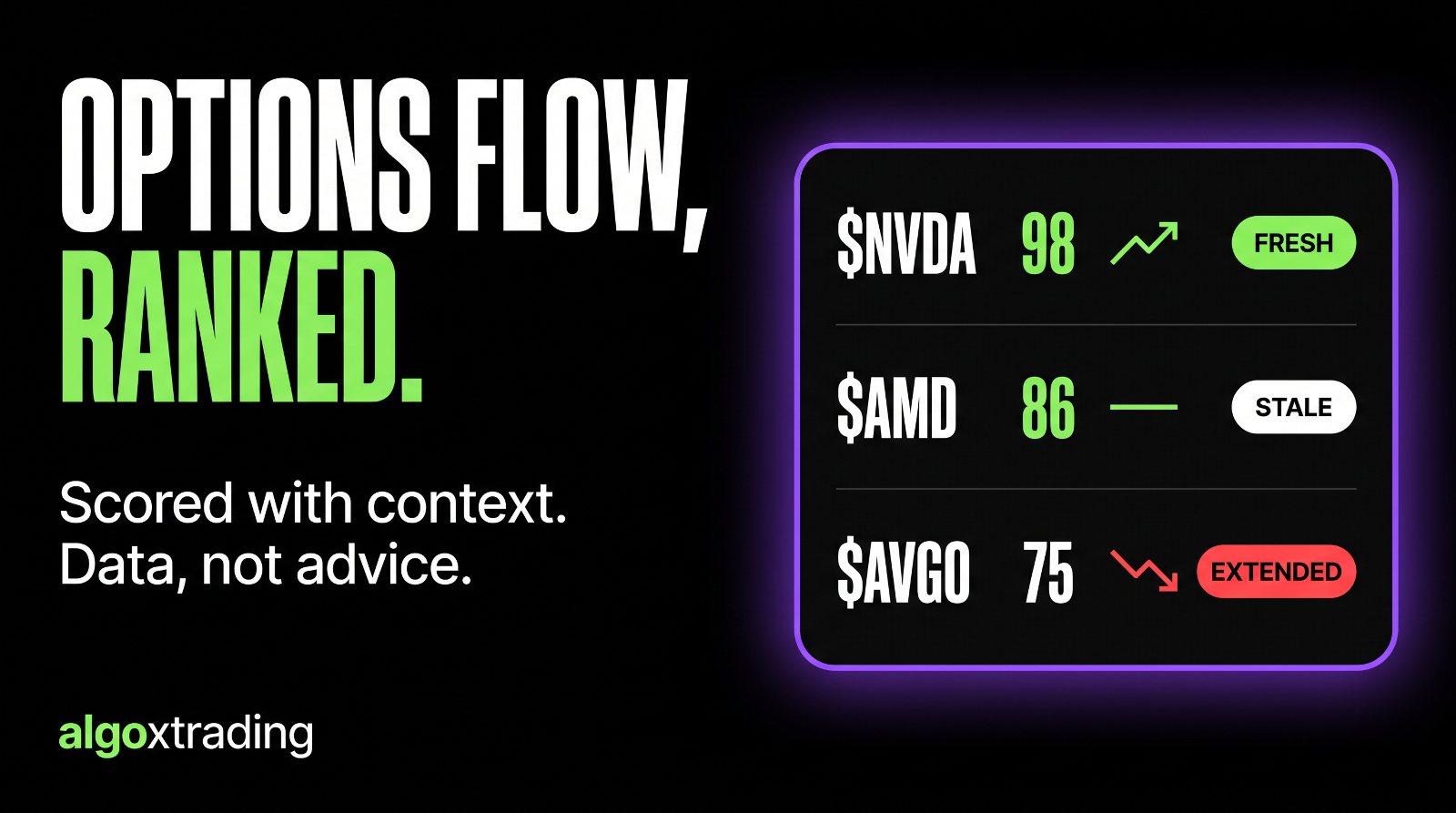
Options flow is the live stream of options trades printing on the tape — especially the large, notable ones. Because each print shows the contract, the size, the price, and whether it hit the bid or the ask, you can read where big money is leaning: which strikes, which expirations, and how aggressively. Unusual options activity is the slice of that flow that's abnormally large or aggressive for a given contract. The skill isn't spotting a big trade — scanners do that — it's reading how it traded: bought at the ask, as a sweep, opening new positions, in size, on one side. When those tells line up, you're looking at conviction. When they don't, it's noise.
Anatomy of a flow print
Every alert is the same handful of fields. Learn to read them at a glance and the tape starts to talk:
The six tells that actually matter
Reading flow well is reading these six dimensions together. Any one alone is noise; the edge is confluence.
Did the trade hit the ask (buyer paid up to get filled now) or the bid (seller hit the bid to get out)?
A sweep is one order split across exchanges and filled immediately; a block is one big negotiated print.
Total dollars spent. A $6M print is a different signal than a $60k one — real money commits real premium.
Is today's volume opening new positions or just churning old ones? Volume above open interest is the tell.
Is the day's flow in a name lopsided to calls or puts? One print is anecdote; a skew is a lean.
Short-dated (0–7 DTE) is urgent and gamma-sensitive; longer-dated is a positioning/conviction bet.
Aggression, seen on the spread
The bid/ask tell is worth picturing. The market for a contract is a bid (buyers) and an ask (sellers). Where the trade prints tells you who was the aggressor:
Reading one alert, start to finish
Put the six tells together on the NVDA print above and it reads as one clean sentence:
| Tell | This print | Reads as |
|---|---|---|
| Aggression | At the ask | Buyer paid up — urgent demand |
| Urgency | Sweep | Wanted in immediately, across the book |
| Size | $6.2M | Real money, not a flyer |
| Positioning | Opening | A new position, not closing an old one |
| Direction | Calls | Bullish lean |
| Time | ~3 weeks | A near-term catalyst bet, not a lotto |
The read: "Someone aggressively bought $6.2M of new, slightly-OTM NVDA calls in a hurry, three weeks out." That's a conviction bullish bet worth watching — not a guarantee, but every tell points the same way. Now compare that to the same $6.2M in calls sold at the bid, or in a far-dated deep-OTM lotto: same headline, opposite meaning.
What flow can't tell you
This is the part that separates people who use flow from people who get hurt by it. Flow is powerful evidence — but it is not a crystal ball:
- You only see one side. A big call buy might be one leg of a spread, a hedge against short stock, or a market maker's print. The tape doesn't label intent.
- Big and bullish aren't the same. Heavy put buying can be a bearish bet or insurance on a long position. Direction is a lean, not a fact.
- Lottos lie. Cheap, far-OTM contracts light up scanners with huge contract counts and tiny premium. Weigh by dollars, and know most expire worthless.
- Someone can be wrong. Smart money is still money that's sometimes wrong. Flow tells you the bet was made — not that it pays.
How the desk scores it
Our Conviction Desk automates exactly this framework — it ranks names by a single score built from net premium (bought vs sold), call/put ratio, relative volume, volume vs open interest, momentum, and the biggest sweep bought at the ask. That's the six tells above, turned into a number, so the strongest positioning floats to the top instead of you scrolling a raw feed. The free unusual options activity page shows today's biggest ask-side sweeps live.
Frequently asked
What is options flow?
Options flow is the real-time record of options trades printing on the tape — especially the large, notable ones. Because every trade shows the contract, size, price and whether it hit the bid or the ask, flow lets you see where big money is positioning: which strikes, which expirations, and how aggressively. "Unusual options activity" is the subset of that flow that's abnormally large or aggressive relative to a contract's normal volume.
What does "bought at the ask" mean in options flow?
Every option has a bid (the highest price buyers will pay) and an ask (the lowest sellers will accept). A trade at the ask means the buyer paid up to get filled immediately — aggressive, buyer-initiated demand. A trade at the bid means the seller hit the bid to get out. At the ask on calls reads as bullish urgency; at the bid reads as supply. Aggression is one of the most important tells in the flow.
Is unusual options activity always bullish?
No. A large call sweep bought at the ask leans bullish, but it could be a hedge, one leg of a spread, or a market maker's print — you only ever see one side of the trade. Big put buying can be a bearish bet or downside insurance on a long stock position. Flow shows positioning and conviction, not a guaranteed direction — read it as evidence, not a signal.
Can you make money following options flow?
Flow is an edge, not an autopilot. Traders who use it well combine several tells — aggression (at the ask), urgency (a sweep), size (premium), new positioning (volume above open interest), direction (skew) and time (DTE) — and only act when they agree, then manage risk with defined stops. Blindly copying a single print, especially far out-of-the-money lottos, is how people lose money in the flow.
What's the difference between a sweep and a block?
A sweep is one order split across multiple exchanges and filled immediately — it signals urgency. A block is a single large negotiated trade, often printed away from the exchanges — it signals size and planning. Sweeps tell you about urgency; blocks tell you about conviction-sized positioning. There's a full breakdown in the sweeps-vs-blocks guide.
See the flow read live
We call out the prints that matter — bought at the ask, opening, in size — in the free Discord, and rank them on the Conviction Desk. Before the trade, not after. 3,600 traders, wins and losses both on the board.
Get the morning's biggest flow in your inbox
The top conviction names, the day's key levels and the heaviest options flow — free, every morning. No card, no Discord required.
No spam. Unsubscribe anytime. Just the daily flow.