 ← AlgoxFlow
What is max pain in options?
Every options chain has a price that would hurt the most buyers at once. It has a name, it is calculable in about ten lines of arithmetic, and it is one of the most over-claimed numbers in retail trading. Here is the honest version.
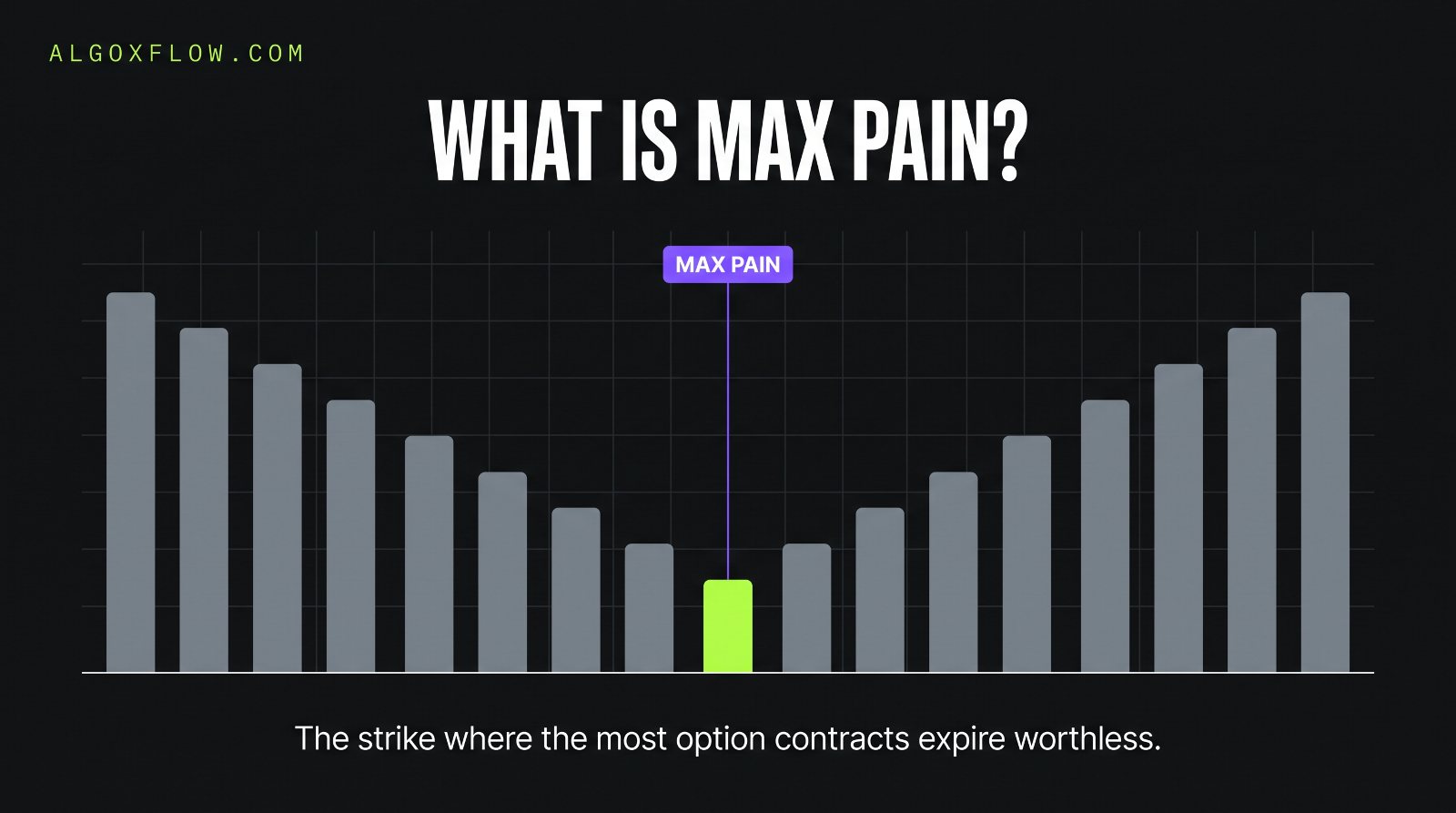
Max pain is the strike price at which the largest total value of open options contracts expires worthless. It is the closing price that costs option buyers the most — and hands option sellers the most. You find it by testing every strike, adding up what all the in-the-money calls and puts would pay out at that price, and picking the strike where that total is smallest.
The idea in one sentence
Options are a zero-sum transfer. Every dollar an option buyer collects at expiry is a dollar an option seller pays out. So for any given expiration, there is some closing price that minimises the total payout to buyers — and that price is max pain.
It is worth being precise about what that is not. Max pain is not a forecast, not a target anyone has committed to, and not evidence of a conspiracy. It is a description of the current open interest, and open interest changes every day.
How max pain is calculated
The calculation is genuinely simple. For a single expiration:
close − strike if the close is above its strike, otherwise zero. A put pays strike − close if the close is below, otherwise zero. Multiply each by its open interest (and by 100, though the multiplier cancels out for finding the minimum).A worked example
Take a stock trading at $103 with a small chain. Five strikes, open interest as shown:
| Strike | Call OI | Put OI |
|---|---|---|
| 95 | 400 | 1,200 |
| 100 | 1,500 | 2,000 |
| 105 | 3,000 | 800 |
| 110 | 2,200 | 300 |
| 115 | 900 | 100 |
Now test each strike as a possible close. Payouts in thousands of dollars (contracts × 100 × intrinsic value):
| If it closes at | Calls pay | Puts pay | Total |
|---|---|---|---|
| $95 | $0k | $2,450k | $2,450k |
| $100 | $200k | $850k | $1,050k |
| $105 | $1,150k | $250k | $1,400k |
| $110 | $3,600k | $50k | $3,650k |
| $115 | $7,150k | $0k | $7,150k |
A close at $100 costs the sellers least: $1.05M, against $1.4M five dollars higher and $2.45M five dollars lower. That is max pain — and notice it sits below the $103 spot. Max pain is not "where the stock is". It is wherever the open interest happens to be stacked.
Notice how lopsided the far ends are. A close at $115 would cost sellers $7.15M, nearly seven times the max pain figure, because every call below it finishes deep in the money. That asymmetry is the whole reason the number is worth glancing at.
Why price sometimes drifts toward it
Here is where most articles go wrong. The popular story is that market makers "push" the stock to the strike that hurts buyers most. That would require coordination across dozens of firms, and it is not what happens.
The real mechanism is duller and much more convincing: delta hedging.
Dealers who have sold options hedge their exposure by trading the underlying. When they are net long gamma — which is typical around heavily traded strikes — that hedging is mechanically mean-reverting. The stock rises, they sell into it. The stock falls, they buy. Neither trade is a view; both are risk management.
The strikes with the most open interest generate the most hedging, and those strikes tend to cluster near max pain. So price gets damped in that region — not steered there. This is the same dealer-hedging machinery behind dealer gamma exposure, and it runs in reverse during a gamma squeeze.
When it matters — and when it doesn't
The last day or two before a large monthly or quarterly expiration. Very liquid names with concentrated open interest. Quiet tape, no catalyst. Spot already close to the max pain strike.
Any real news, earnings, or macro print. Big index moves that drag everything. Thin or illiquid chains. Early in an expiration cycle. Spot far from max pain with no reason to travel.
The honest summary: max pain is a weak, conditional effect that shows up best in the final hours of a big expiry in a crowded name. It is a piece of context, not a signal. Anyone selling it as a reliable price prediction is overselling it, and the strongest tell is that they never mention the conditions above.
Max pain vs the gamma flip
These get conflated constantly, and they answer different questions.
Built from open interest. Answers: at what price do the most contracts expire worthless? One target price, for one expiration, most relevant at expiry.
Built from dealer gamma exposure. Answers: where does dealer hedging switch from damping moves to amplifying them? A regime boundary that changes how the stock behaves, every day.
If you only have room for one number, the flip is the more useful one — it tells you what kind of day you are in rather than where a single expiry might settle. Both are on the free gamma map, alongside the call wall and put wall.
How to use it without fooling yourself
- Treat it as a zone, not a decimal. Open interest shifts daily, and a large block can move the figure several dollars. "Around 100" is honest; "100.00" is not.
- Check it against the flip. If max pain and the gamma flip point at the same area, the pinning case is stronger. If they disagree, the flip usually wins.
- Never trade it into a catalyst. Earnings, CPI or a Fed day overwhelms it completely.
- Recalculate on the day. A number from Monday is stale by Thursday.
- Size for being wrong. This is a mild statistical lean, not a floor or a ceiling.
Frequently asked
What is max pain in options?
The strike price at which the largest total dollar value of open call and put contracts would expire worthless — the closing price that costs option buyers the most in aggregate, and therefore benefits option sellers the most. It is derived entirely from current open interest.
How is max pain calculated?
Assume the stock closes at each strike in turn. At each candidate price, total the intrinsic value of every in-the-money call (close − strike) and put (strike − close), weighted by open interest. The strike producing the smallest total payout is max pain.
Does the stock always close at max pain?
No, and it is not close to always. It is a mild pull that shows up most in the final day or two of a large expiration in heavily traded names on a quiet tape. Any real news, earnings or broad market move overrides it entirely.
Is max pain manipulation?
Almost certainly not. The simpler explanation is delta hedging: dealers who are long gamma buy dips and sell rallies as a matter of risk management, and that damping is strongest near high-open-interest strikes. No coordination is needed to produce the effect, and the effect is much weaker than the theory's fans suggest.
What is the difference between max pain and the gamma flip?
Max pain comes from open interest and gives one target price for one expiration. The zero-gamma flip comes from dealer gamma exposure and marks where hedging switches from damping moves to amplifying them. The flip describes the regime; max pain describes a settlement magnet.
Where can I find max pain for a stock?
Our free gamma map calculates it live for any ticker, alongside the zero-gamma flip, the call wall and the put wall. No signup required.
See max pain on any ticker, free
Type a symbol and get the live dealer gamma map — zero-gamma flip, call wall, put wall and max pain, calculated from today's options chain. No signup, no card.
Educational content from AlgoX Flow · not financial advice · options carry substantial risk of loss.